
Almost every mountain property already has water moving across it. It runs off the roof, sheets down the driveway, and seeps out of the bank after a week of rain. A well-built water feature takes some of that sound and life and puts it where you can enjoy it: outside the kitchen window, beside the patio, at the bottom of a slope that used to be nothing but a problem.
It is also one of the easiest parts of a landscape to get wrong. A pond in the wrong spot turns green every August, fills with oak leaves every November, and becomes the most expensive puddle in the neighborhood. This is how we think through water features on Asheville and Western North Carolina properties: which type fits your yard, where to put it, what to plant in and around it, and what it really asks of you once it is built.
The four kinds of water feature we build most
Ponds
A true pond holds a standing body of water, usually with a liner, a pump, a filter, and a recirculating stream or waterfall. It is the only option if you want fish or deep-water plants such as water lilies, and nothing else gives you the same reflection and stillness. It also asks the most of you. A pond is a small ecosystem, and it needs balance between plants, filtration, and sunlight to stay clear.
Pondless waterfalls and streams
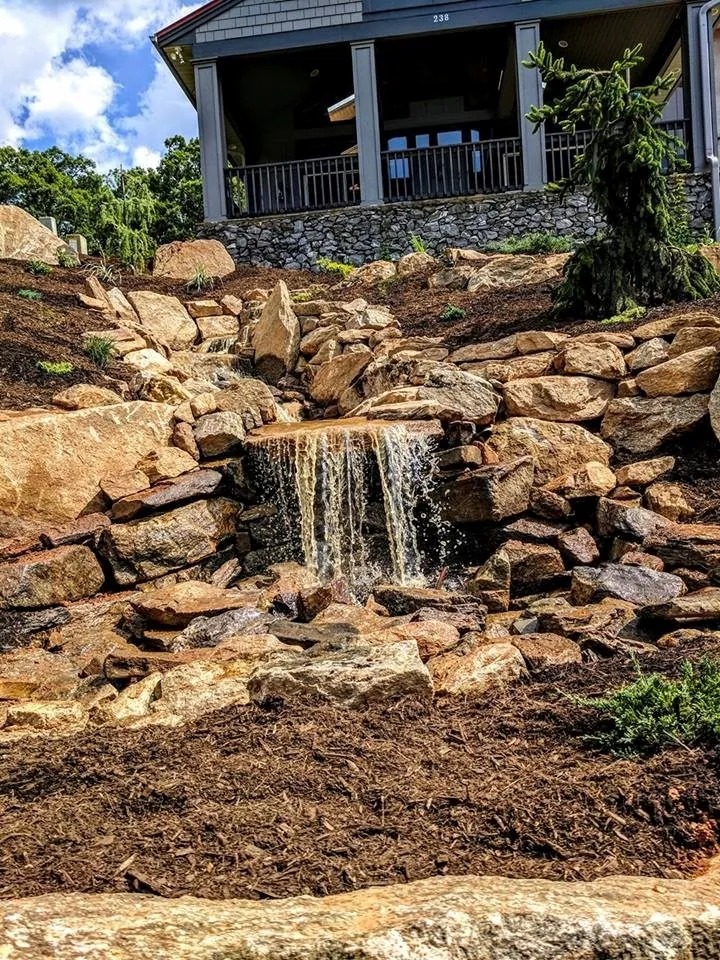
A pondless feature gives you the sound and movement of a waterfall without open standing water. The water tumbles over stone and disappears into a gravel-filled basin underground, where a pump sends it back to the top. For a lot of families this is the right answer: there is no open water for small children to fall into, far less for leaves and algae to work on, and it can be switched off for a trip or for the winter without anything going wrong. On a sloped lot it also looks completely at home, because a stream coming down a hillside is exactly what the mountains do on their own.
Fountains and bubbling features
A fountain, a drilled boulder, or a bubbling urn is the smallest commitment. The reservoir is hidden, the footprint is tiny, and it fits on a patio or in a courtyard bed where a pond never would. If what you really want is the sound of water near where you sit, this is often the best value in the whole category. It pairs well with the kind of patio and seating area we cover in our guide to outdoor living spaces in Asheville.
Bogs and natural water gardens
A bog garden is a planted area kept permanently wet, either on its own or as the edge of a pond where it doubles as a natural filter. Bogs are a particular fit for Western North Carolina. Southern Appalachian mountain bogs are among the rarest habitats in the region: The Nature Conservancy estimates North Carolina once had nearly 5,000 acres of them and only about 500 acres remain. A backyard bog will not replace that, but it gives frogs, dragonflies, and pollinators the kind of wet ground that has mostly disappeared from our valleys.
Where to put it
Placement decides more about how a water feature performs than any piece of equipment does. A few rules we come back to on almost every site:
- Put it where you will see and hear it. A pond at the far end of the yard gets looked at twice a year. One you can see from the kitchen or hear from the porch gets enjoyed every day.
- Balance sun and shade. Water plants need sun to bloom, but full afternoon sun on shallow water is what feeds algae in July. Morning sun with some afternoon shade is the sweet spot for most ponds here.
- Stay out from under big trees. Oaks, maples, and tulip poplars drop an enormous volume of leaves into water every fall, and their roots do not mix well with a liner. Pondless features and fountains are much more forgiving near trees.
- Do not build in the low spot that floods. It is tempting to put a pond where water already collects. But storm runoff carries silt, fertilizer, and whatever is on the driveway straight into it, and a heavy rain can overflow it. A feature should be fed by a pump, not by the next storm.
Work with the slope instead of against it
Flat ground is scarce here, and that is an advantage for water. A slope gives a waterfall natural height, so a stream can follow the fall of the land instead of sitting on top of an artificial mound. The same boulders and stonework that hold a mountain yard together, which we cover on our hardscaping in Asheville page, can form the steps and pools of a stream so that it reads as part of the hillside.
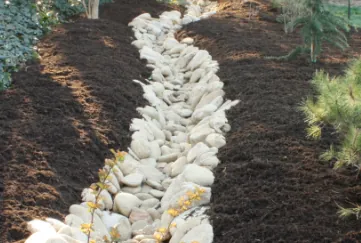
What a slope does demand is proper grading. The top of the feature has to be level where the water spills, the basin has to sit on firm, compacted ground, and surface runoff from above has to be steered around the feature rather than through it. On many properties we build the water feature and the drainage together, because a dry creek bed or French drain that carries storm water away is what keeps the recirculating feature clean. A dry creek bed can also be the right answer on its own if what you like is the look of a streambed without a pump.
Clay soil, rain, and the liner
Our red clay holds water well enough that people sometimes ask whether they can skip the liner. For a small garden pond the answer is almost always no. Clay cracks as it dries in a late-summer dry spell, roots and burrowing animals find their way through it, and the water level becomes impossible to hold. A flexible rubber liner laid over an underlayment, with stone set on top, is what makes a pond reliable. Heavy mountain rain matters too: every pond needs a planned overflow so that a downpour leaves through a spot you chose, not by spilling over the edge and washing out a bed.
What to plant in and around the water
Plants are what make a water feature look like it belongs, and they do real work: they shade the water, compete with algae for nutrients, and give wildlife cover. Natives that do well in wet ground here include pickerelweed, cardinal flower, blue flag iris (Iris virginica), swamp milkweed, soft rush, lizard's tail, and native sedges. Planted in layers from the deep water out to the damp edge, they soften the stone and fill in quickly.
One plant to avoid, even though garden centers sell it: yellow flag iris (Iris pseudacorus). NC State Extension notes that the North Carolina Invasive Plant Council lists it as invasive, and it spreads by seed and rhizome into wet ground well beyond the pond. Water that leaves your property eventually meets a creek, so it is worth choosing plants that will not cause trouble downstream.
If you have a dog, keep the plantings around the edge pet-safe, and think about where the dog will get in and out. Our guide to pet-friendly landscaping covers the plants to skip. Deer will browse around a pond like anywhere else, so the ideas in our deer-resistant landscaping guide apply to the planting at the water's edge too.
Wildlife: the part people do not expect
Add water to a mountain yard and wildlife finds it fast: frogs within a season, dragonflies, birds bathing in the shallow edges, and salamanders under the stones. That is the best part of a natural water feature, and it is why we build most ponds with a gently shelving edge and flat stones at the waterline, so animals can get in and out.
It also means planning for the visitors you did not invite. Great blue herons are common along our rivers and will happily clean out a shallow fish pond, and raccoons will try. Deeper areas, overhanging stone, and plant cover give fish a place to hide. If wildlife is the goal rather than fish, skip the fish altogether; frogs and dragonflies do far better in a pond without fish eating their young.
As for mosquitoes, NC State Extension points out that mosquitoes need water to complete their life cycle, which is why still, neglected water is the problem. Moving water from a pump and waterfall, plus the dragonflies and other predators a healthy pond attracts, keeps a well-built feature from becoming a breeding ground. Pondless features, with no open standing water, largely sidestep the issue.
The seasons in the mountains
Water features here go through a real winter. We regularly see freezes, and freeze and thaw cycles move stone and heave anything set on poorly compacted ground. Pumps in a pond can usually run through a mild winter, but a stream that ices over can divert water out of its channel, so many people turn waterfalls off during hard cold snaps. Pondless features can simply be shut down and drained until spring.
Fall is the busiest season for maintenance. A net over a pond through leaf drop, or a skimmer that catches leaves before they sink, saves a messy spring cleanout. Spring is when we check the pump, top up the gravel and stone that shifted over winter, and divide plants that have outgrown their spot. It is also a good time to build, because the plants can establish before summer.
What it takes to maintain one
Honest expectations matter here, because a water feature is not zero maintenance. From least to most work, the order is roughly fountain, pondless waterfall, bog garden, planted pond, fish pond. Most of the ongoing work is skimming leaves, cleaning the pump intake, topping up water lost to evaporation in summer, and trimming plants. If a low-maintenance yard is your priority, a pondless stream or a fountain gives you most of the pleasure for a fraction of the upkeep, and it fits the approach in our low-maintenance landscaping guide.
What drives the cost
We do not publish price lists for water features, because two features that look similar on paper can be very different builds. The main factors are the type and size of the feature, how much stone it uses and how big the boulders are, access for equipment on a steep or tight lot, the grading and drainage work around it, running power to the pump, and the extent of the planting. A small fountain and a large pond with a long stream are different jobs in every one of those respects. The most expensive mistake is a feature in the wrong place, because moving a pond means building it twice.
Before you dig
North Carolina law requires you to notify NC811 at least three working days before you dig, so buried utility lines can be marked, and that applies to a garden pond as much as a new foundation. Some jurisdictions treat deeper ponds like swimming pools for fencing purposes, so check with City of Asheville or Buncombe County permitting before you plan a deep pond, and read your HOA rules if you have them. If children visit often, that is one more reason to consider a pondless design.
We have been designing and building landscapes across Asheville, Buncombe County, and the Western North Carolina mountains since 1997, and water features have always been part of that work, from small fountains to ponds with long rock streams. You can see examples among the landscape projects we have built, including a pondless waterfall and several natural ponds, read more about our water feature and landscaping services, or schedule a consultation and we will walk your property and help you decide what kind of water, if any, it is suited to.
Frequently asked questions
What is a pondless waterfall?
A pondless waterfall gives you the sound and movement of falling water without an open pond. The water runs over stone and drains into a gravel-filled basin underground, where a pump sends it back to the top. With no standing water it is safer around small children, collects far fewer leaves, and can be switched off for a trip or for the winter.
Do backyard ponds attract mosquitoes in Asheville?
A well-built one should not. Mosquitoes need still water to complete their life cycle, so the trouble comes from stagnant, neglected water. Moving water from a pump and waterfall, plus the dragonflies, frogs, and other predators a healthy pond attracts, keeps a pond from becoming a breeding ground. Pondless features have no open standing water at all.
Can I build a pond without a liner in clay soil?
For a garden pond, almost never. Red clay holds water when it is wet, but it cracks in late-summer dry spells, roots and burrowing animals work through it, and the water level becomes impossible to hold. A flexible rubber liner over an underlayment, with stone on top, is what makes a pond reliable in our soil.
What plants are good for a pond or bog garden in Western North Carolina?
Natives that do well in wet ground here include pickerelweed, cardinal flower, blue flag iris (Iris virginica), swamp milkweed, soft rush, lizard's tail, and native sedges. Avoid yellow flag iris (Iris pseudacorus): the North Carolina Invasive Plant Council lists it as invasive, and it spreads into wet ground well beyond the pond.
What do I do with a water feature in winter?
Pumps in a pond can usually run through a mild winter, but a waterfall that ices over can push water out of its channel, so many people turn streams off during hard cold snaps. Pondless features can simply be shut down and drained until spring. Netting a pond through fall leaf drop saves a messy spring cleanout.
Thinking about a project like this?
We've been designing and building landscapes across Asheville and Western North Carolina since 1997. Tell us about your property and we'll walk it with you.
Schedule a consultation or call 828-624-5136