

Retaining walls, flagstone patios, stone walkways and steps, boulder terraces, and fire features for homes across Asheville, Buncombe County, and the Western North Carolina mountains. Designed and built by the same crew since 1997, and built for a slope first.
Hardscaping is the stone and structural half of a landscape: everything that holds the ground in place, gets you from one level to the next, and gives you somewhere flat to sit. In Asheville, it is usually where a project has to start, because almost no lot here is level and almost every one of them moves water.
We are a residential design-build company, so the person who walks your slope with you is connected to the crew that sets the stone. Hardscaping is one of our five landscaping services, and most of our projects combine it with grading, drainage, and planting so the finished yard works as one piece. You can see the range in our completed projects.
What we build
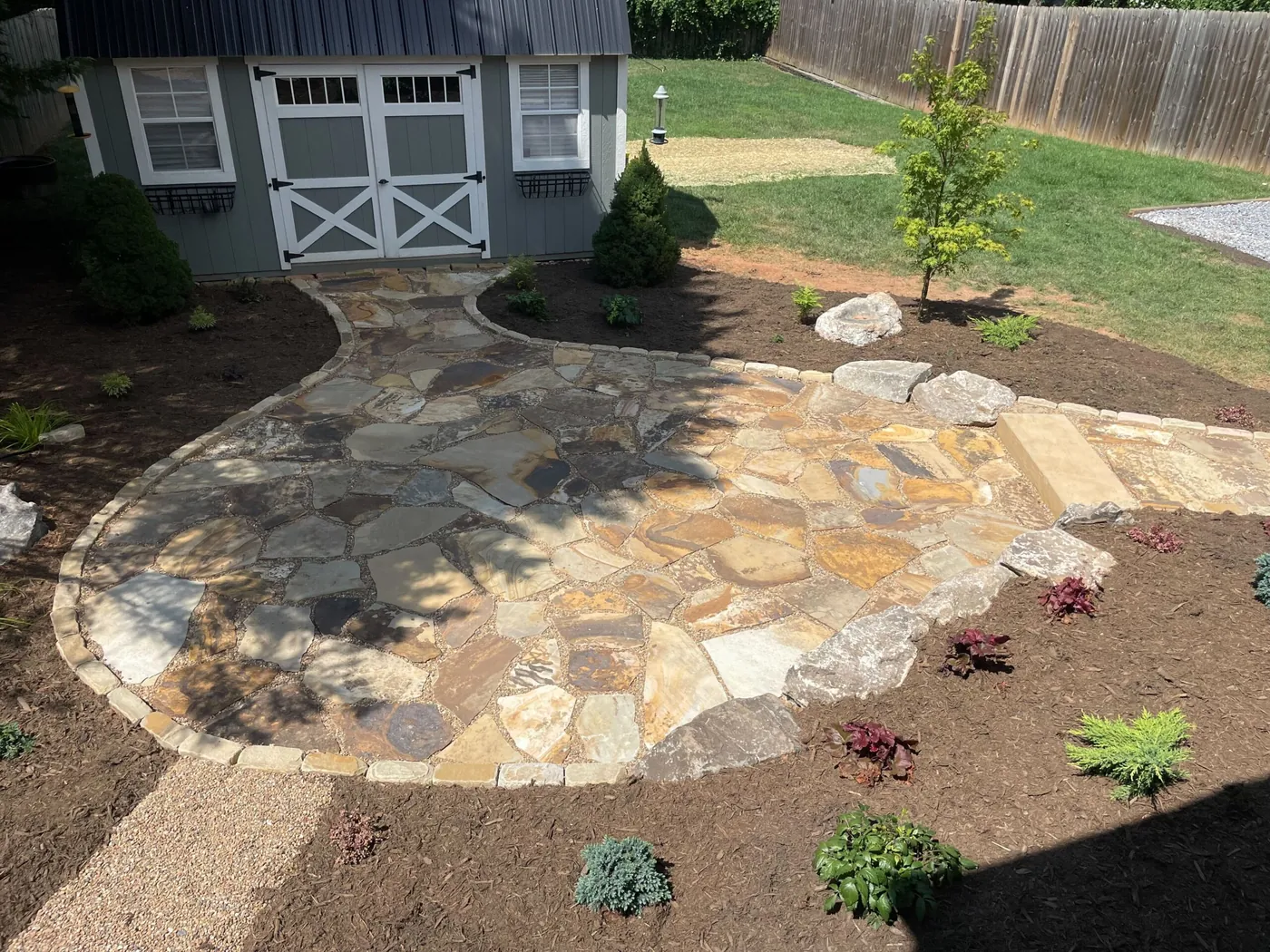
Hand-laid natural flagstone, interlocking concrete pavers, or compacted gravel, each set on an excavated and compacted aggregate base so it stays flat through our freeze and thaw winters. Our guide to flagstone vs. pavers for an Asheville patio walks through how we choose the surface.
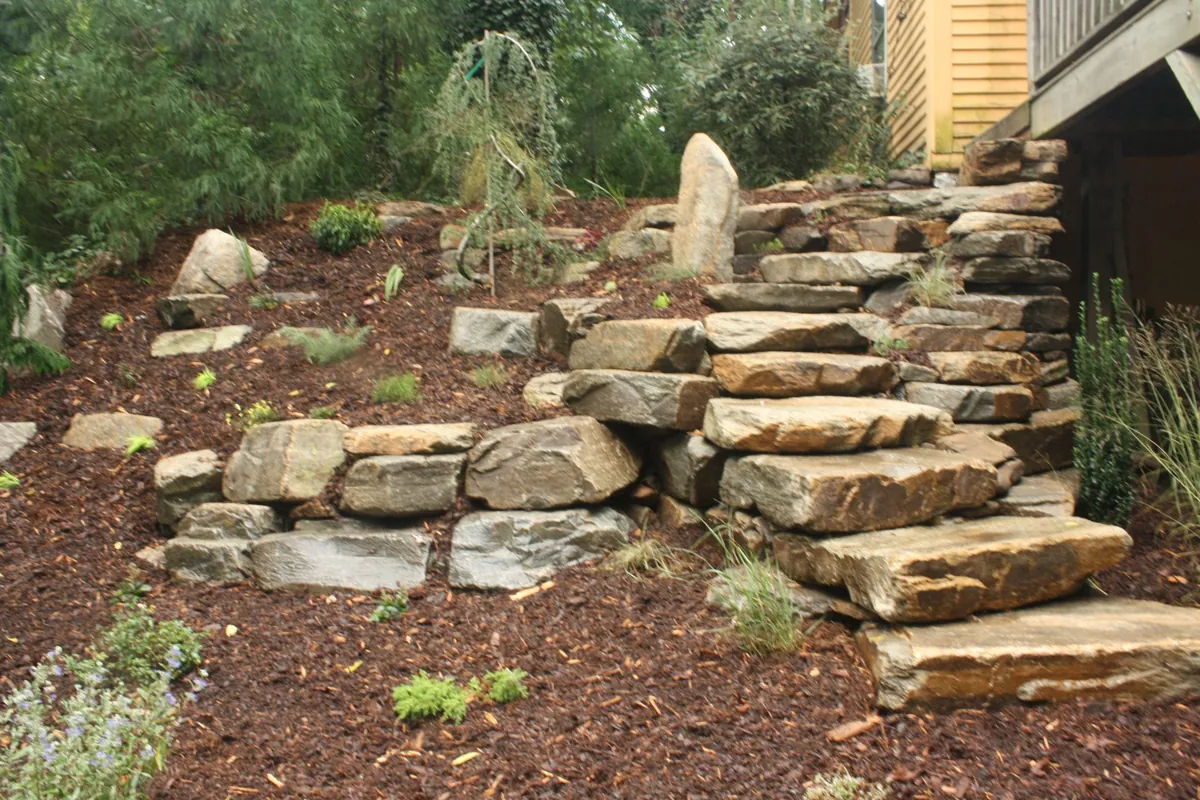
A retaining wall is what turns a slope into a yard. We build dry-stacked and mortared natural stone walls, native boulder walls, and engineered segmental block walls, and every one of them gets gravel backfill, filter fabric, and a drain behind it, because water pressure is what pushes walls over in these mountains. Our guide to choosing a retaining wall in Western North Carolina explains the trade-offs.
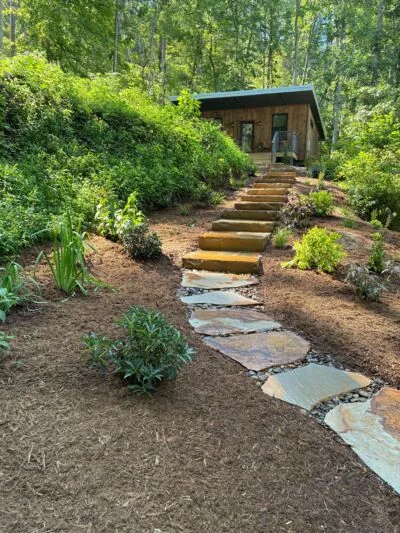
We build flagstone and stepping-stone paths, brick and paver walkways, and stone stairways cut into the hillside with generous treads that are safe in the wet and the dark. For Robyn and Bruce in Weaverville, that was a crab-orchard and flagstone stairway down a steep slope to a new guest house, built to replace a gravel fix that kept washing out.
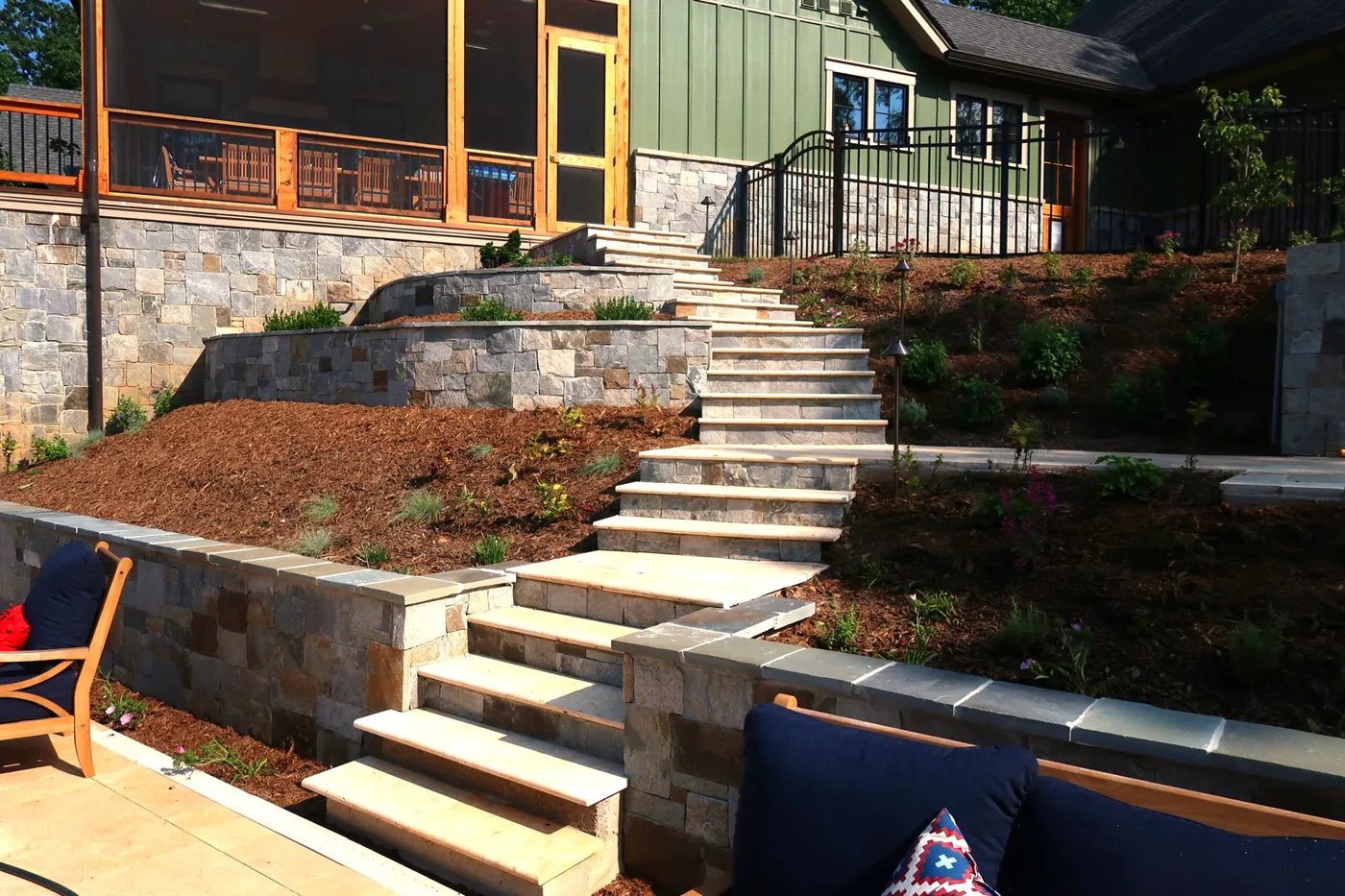
Some slopes are too steep or too long for one wall. Terracing breaks the grade into a series of shorter walls with planted beds between them, which holds the soil, slows the water, and turns a bank you could never use into garden space you can walk through. We set large native boulders as accents, as steps, and as low walls.
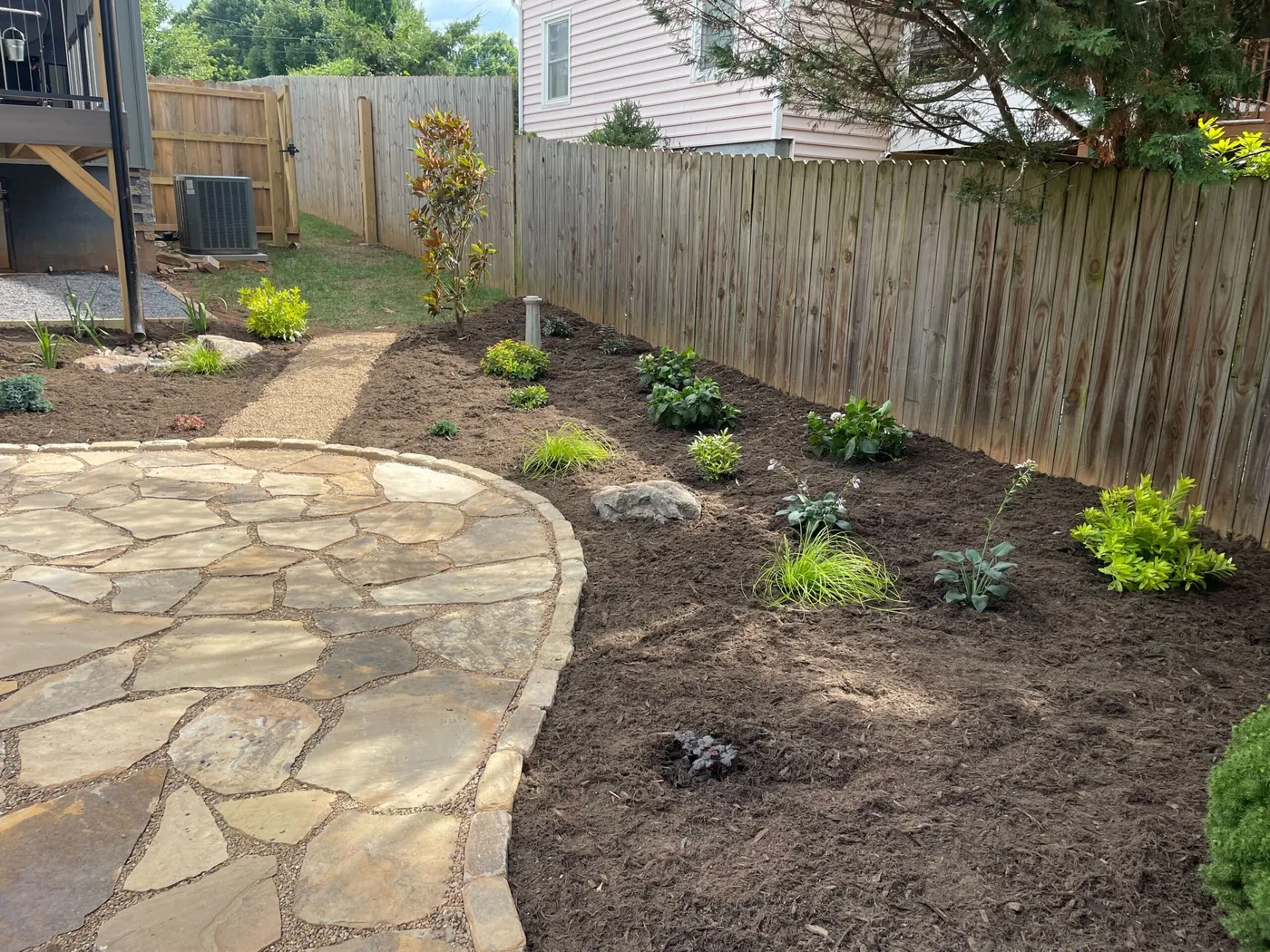
Our evenings cool off fast at this elevation, which is why a fire feature gets so much use in an Asheville yard. We build stone fire pits, outdoor fireplaces, natural-stone kitchen surrounds, and the seat walls and patio areas around them. For Greg and Ashley in West Asheville, that was a patio and fire pit area beside the deck they already had. Our guide to outdoor living spaces in Asheville covers what to build first.
Why it is different here
Most of the failed hardscape we get called to fix was built the way it would be built on flat ground. Four things make hardscaping in Asheville and Western North Carolina its own discipline.
A patio has to be level and a walkway has to be walkable, so on a hillside the real work is cut, fill, and the wall that holds both. Access matters as much as the grade: on a tight lot where a machine cannot reach the back yard, every stone and every scoop of soil moves by hand, and that changes a project more than any material choice will.
Every hard surface you add is ground rain can no longer soak into, and on a slope that water moves fast. Helene showed the whole region what unmanaged runoff does to a slope, and a lot of Asheville yards are still carrying gullies, washed-out paths, and leaning walls from it. We pitch every surface, drain every wall, and give the runoff a planned route, whether that is a French drain, a catch basin, or a dry creek bed that becomes a feature. Our guide to yard drainage on Asheville's slopes covers the options.
Our clay subsoil holds water, that water freezes and expands, and it lifts whatever is sitting on top of it. That is where rocking flagstones, gapping pavers, and bellied walls come from. The fix is unglamorous: take out the top of the clay, replace it with graded stone, and compact it in layers. It is invisible when finished, and it is most of the difference between hardscape that lasts decades and hardscape that needs relaying in five years.
The best hardscape in these mountains looks like it was uncovered rather than delivered. We work in native and regional stone wherever the design and budget allow, fit it by hand around boulders and tree roots instead of demanding a clean rectangle. It is the same instinct behind every project in our portfolio.
How it works
Every project starts with a consultation on site. We look at the grade, where the water goes in a storm, how a machine would get in, what the soil is doing, and how you actually want to use the space.
We design the hardscape and the planting together, so the walls, steps, drainage, and beds are one plan rather than three contractors' worth of guesses. You see what is proposed and why before anything is built.
Grading and drainage first, then walls and base, then the surfaces, then the planting that softens the edges. Because the same company designs and builds, nothing gets value-engineered out of the plan behind your back.
Hardscape is the least seasonal work we do. The genuine limits are frozen ground and saturated clay, because a base cannot be compacted in mud, which makes late summer and fall a strong stretch to build.
Where we work
Our studio is on Haywood Road in West Asheville, and we build residential hardscape throughout Buncombe and Henderson counties.
Good to know
Hardscaping is the built, non-living part of a landscape: patios, retaining walls, walkways and steps, terraces, boulder work, fire pits and fireplaces, and the base and drainage underneath all of it. Softscape is the planting. On a mountain property the two depend on each other, which is why we design and build them together.
Yes, and most of our work is on sloped lots. A patio has to be level, so we cut into the hill on the uphill side, fill on the downhill side, and hold both with a retaining wall or terraces. The wall, grading, and drainage are built before any surface goes down, and that site work is what makes a hillside project bigger than a flat-lot one.
Water, almost every time. Soil behind a wall holds water and that pressure pushes the wall over, and our clay subsoil freezes, expands, and lifts any patio set straight onto it. Hardscape built on a compacted aggregate base, with gravel backfill and a drain behind every wall and a planned route for runoff, does not do this. When you compare bids, ask each builder how deep the base goes and how they handle water behind the wall.
An at-grade patio is usually straightforward. A retaining wall more often triggers review, depending on its height, what it holds back, and whether your property is inside Asheville city limits or in unincorporated Buncombe County, which are administered separately. Taller walls generally need engineering as well as a permit. We handle that process as part of the project when a wall requires it.
We do not publish square-foot prices, because on mountain lots they mislead more than they help. The real drivers are grade change, machine access, drainage, material, and extras like steps, seat walls, and fire features. Natural Scapes has a $20,000 project minimum for all work, and after we walk your property we can tell you honestly what your project would take.
Keep exploring
French drains, dry creek beds, regrading and erosion control that hold up on steep, clay-heavy WNC lots.
Read the drainage guideA backyard for owners who travel: native plantings that thrive unattended, thoughtful hardscaping and a patio fire pit.
See the West Asheville projectA garden expanded after hurricane damage with native plants and trees that feed wildlife year-round, a food forest and a meandering path.
See the wildlife garden projectPractical advice on drainage, stonework, retaining walls, patios and planting for Asheville and Western North Carolina properties.
Browse all Asheville landscaping guidesLet's begin
Tell us about your property and what you want to build. We'll walk it with you, look at the grade and the water, and design hardscape that holds a mountain lot in place while it looks like it grew there. Please note: Natural Scapes has a $20,000 project minimum for all work.
Schedule your consultation