
Flat ground is the exception in Asheville. Most of the yards we walk in Buncombe County fall away from the house, climb toward the road, or do both, and a lot of them include a bank that nobody has set foot on in years. Owners tell us the same things about those slopes: grass will not grow on them, they are dangerous to mow, mulch washes off every time it storms, and since Helene they look at them a little differently.
A steep lot is not a problem to be erased. Done well, it is the most interesting part of a mountain landscape: terraces you can walk through, stone steps that follow the hill, and planting that holds the soil and looks like it grew there. This guide covers how we approach steep slope landscaping in Asheville and across Buncombe County: reading the slope, controlling erosion, terracing, choosing plants for a bank, handling the water, and knowing when a slope needs a wall, an engineer, or a permit.
Start by reading the slope
Before anything gets planted or built, we figure out three things about a slope: how steep it really is, where the water on it comes from, and whether the ground is stable.
How steep. Slopes are described a few ways, and it helps to know them. A 3:1 slope rises one foot for every three feet across, which is roughly a 33 percent grade. Extension guidance generally treats about that steepness as the practical limit for mowing turf, so a bank steeper than that is usually a better candidate for groundcover, shrubs, or terracing than for lawn. A 35 percent grade rises 35 feet over 100 feet. At 45 degrees (a 100 percent grade, or 1:1), NC Cooperative Extension in Henderson County notes that plants have trouble taking root at all, and the slope needs regrading or a retaining wall. If you want to know the numbers for your own lot, the City of Asheville and Buncombe County publish an online steep slope calculator at mapwnc.org.
Where the water comes from. On mountain lots, the water that erodes a bank often starts well above it: a roof downspout, a driveway, an uphill neighbor, or a seep that only runs after a wet week. Planting a slope without dealing with that water is like mopping under a running faucet.
Whether the ground is moving. Some signs mean you should talk to a geotechnical engineer before you talk to a landscaper: new cracks in the soil at the top of a bank, trees or fence posts that have started to lean, a bulge at the bottom of the slope, or water springing out of a hillside where it never used to. Helene triggered landslides across Western North Carolina, and the NC Geological Survey keeps landslide information and a Helene landslide observation map for the region. Landscaping can protect a stable slope. It cannot fix one that is failing.
Erosion control comes first
Bare soil on a slope is soil that is leaving. Our red clay sheds water fast when it is compacted, and a hard mountain downpour can cut gullies into a freshly graded bank in one afternoon. So the first goal on almost every steep site is to get the ground covered and slow the water down.
- Slow the water across the slope. Logs, stone, or wattles laid along the contour break a long slope into shorter runs, so water never builds the speed it needs to carry soil.
- Cover the soil immediately. Biodegradable erosion-control fabric, such as jute or coir netting staked into the slope, holds seed and soil in place while plants establish, then breaks down on its own. Extension agents in the mountains recommend it for exactly this reason.
- Mulch that knits together. Shredded hardwood mulch locks together on a slope far better than nuggets or pine bark, which float off in the first storm. About three inches over the fabric is typical.
- Plant for roots, not just cover. A dense mix of deep-rooted natives is what holds a bank long term. Turf has shallow roots and is hard to mow on a steep grade; it is rarely the right answer on a real slope.
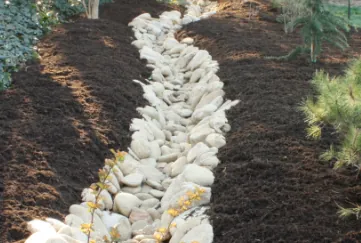
Erosion control on a slope and drainage for the rest of the yard are really one system. Our guide to yard drainage solutions for Asheville's slopes covers the French drains, swales, and dry creek beds that carry water around and off a slope instead of across it.
Terracing: turning a bank into usable ground
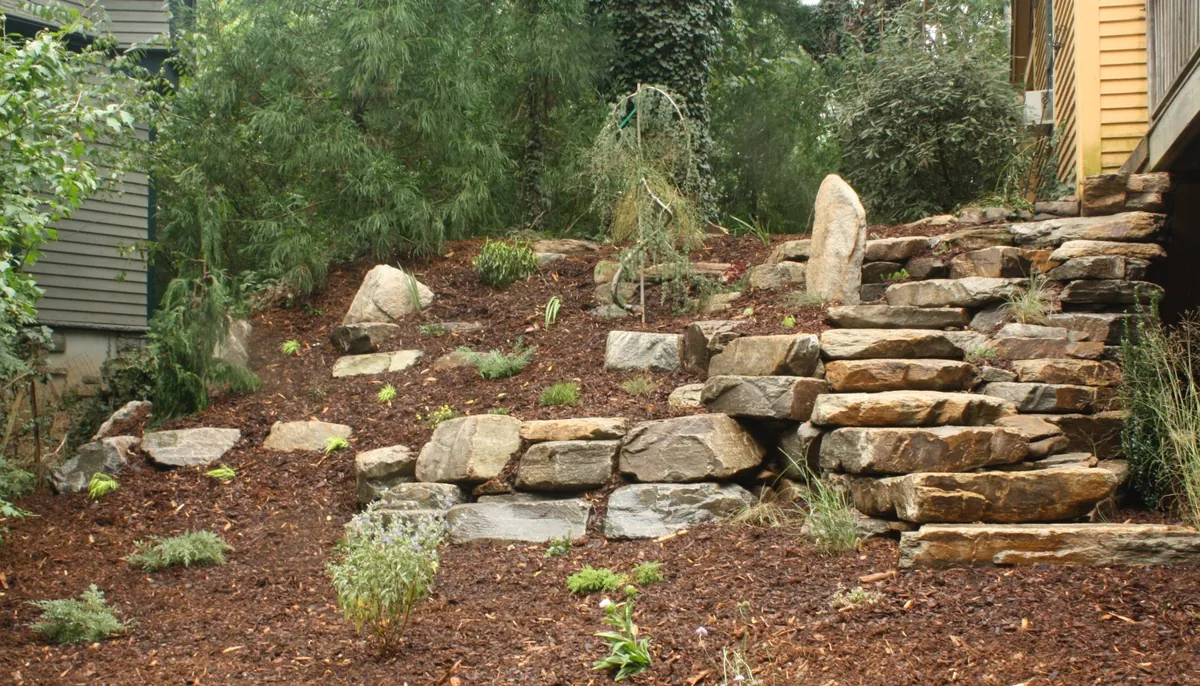
Terracing breaks a long, steep slope into a series of shorter steps, each with a low wall and a level or gently sloped bed behind it. It does three things at once: it slows the water, it gives plants flat ground to root in, and it turns a bank you could never use into garden you can walk through. On many Asheville properties it is the single change that makes a back yard usable.
A few principles we follow when we terrace a mountain slope:
- Several short walls beat one tall one. Keeping each wall low keeps the soil pressure on each one manageable, and a series of low walls usually looks more natural on a hillside than one big wall.
- Every wall drains. Water trapped behind a wall is what pushes it over. Gravel backfill, filter fabric, and a drain behind each wall are not optional, even on a low garden terrace.
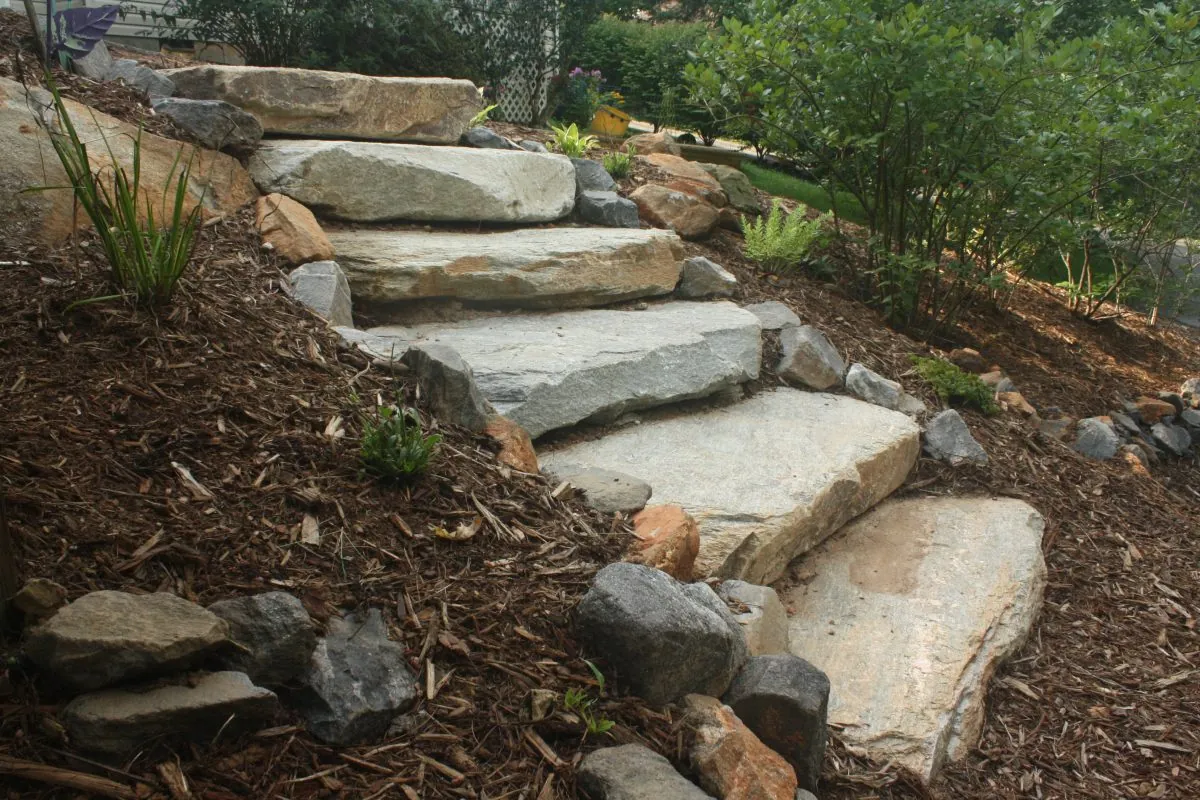
- Match the material to the hill. Native boulders and dry-stacked stone read as part of the mountain and drain freely between the stones. Segmental block is the workhorse when a wall has real structural work to do. Our guide to choosing a retaining wall in Western North Carolina walks through the trade-offs.
- Build in access. Steps or a path between the terraces matter as much as the walls, because a slope you cannot get onto is a slope you cannot weed, water, or enjoy.
Stone steps are often the backbone of a terraced slope. For Robyn and Bruce in Weaverville, we built a crab-orchard and flagstone stairway down a steep slope to a new guest house, with water-loving plants along the path to soak up the runoff that used to wash the old gravel route out. Our hardscaping in Asheville page covers the walls, terraces, stone steps, and boulder work we build on slopes like it.
When a slope needs a retaining wall
Not every slope needs a wall. A moderate bank with stable soil can often be held with plants, fabric, and a few well-placed boulders. A wall becomes the right answer when:
- the slope is too steep for plants to establish, roughly the 1:1 range where Extension says roots struggle;
- you want level ground for a patio, a path, a lawn, or a garden where there is only a slope today;
- soil is actively sliding onto a driveway, walkway, or the back of the house; or
- a cut slope from construction is too steep to stand on its own.
Height is the line that changes everything. Taller walls, generally around four feet and up depending on the jurisdiction and what the wall is holding back, often require engineering and a permit in the Asheville area. A wall that supports a driveway, a structure, or a slope above it can need engineering even when it is shorter. When a wall reaches that territory, we bring in the engineering as part of the project rather than leaving you to sort it out.
Plants that hold a mountain bank
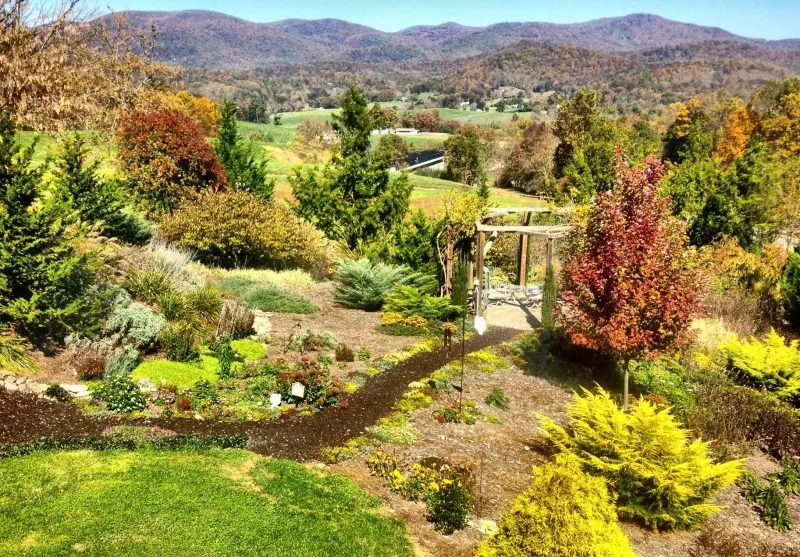
What holds the mountainsides together on their own is a mix of trees, shrubs, groundcovers, and the leaf litter under them. The best steep-slope plantings copy that layering. Native plants that NC Cooperative Extension suggests for slopes in the mountains include:
- Small trees: dogwood, serviceberry, and redbud.
- Shrubs: rhododendron, mountain laurel, leucothoe, Virginia sweetspire (itea), fothergilla, and winterberry.
- Grasses and sedges: little bluestem, switchgrass, river oats, Pennsylvania sedge, and pink muhly, which need no mowing and root deeply.
- Groundcovers: creeping phlox, partridgeberry, and native Allegheny pachysandra for shadier banks.
Match the plants to the light. A south-facing bank that bakes all afternoon wants sun-loving grasses and shrubs; a shady north slope under oaks wants the shade natives. If you see moss on the ground, that is a good sign the bank is shady.
Just as important is what not to plant. English ivy, vinca (periwinkle), and Asiatic jasmine have been sold for decades as slope covers, and Extension agents are blunt about them: they are invasive, they climb and smother trees, and most people who plant them regret it. We see a lot of mountain banks where ivy has taken over and the soil under it is still eroding.
Deer will browse a slope like anywhere else, so the plant list should take them into account; our deer-resistant landscaping guide covers what they tend to leave alone. If storm damage took out the trees that used to shade and anchor your hillside, our guide to replanting trees after storm damage in Asheville covers what to put back and where. And because nobody wants to weed a steep bank on their hands and knees, the ideas in our low-maintenance landscaping guide apply doubly here.
Water at the top, water at the bottom
The best slope plantings fail if a downspout is still dumping onto the top of the bank. Before planting, we look at the top of the slope (where is roof, driveway, and uphill water entering?) and the bottom (where does it go once it gets there?).
At the top, that often means redirecting downspouts into a buried drain, or cutting a shallow swale that catches sheet flow and carries it around the slope. On the face, a planted or rock-lined channel can give concentrated runoff a path that will not erode. At the bottom, the water needs somewhere to go that is not your foundation or a neighbor's yard: a dry creek bed, a rain garden in the right soil, or a drain to daylight. Getting this right is what keeps a newly planted bank from washing out in its first big storm.
Permits and rules for building on steep slopes
Most planting and small-scale terracing on an existing yard does not need a permit. Larger grading work and building on steep ground are a different matter, and the rules depend on where your lot sits:
- Land disturbance. In unincorporated Buncombe County, grading that disturbs an acre or more requires an erosion control permit, and the threshold is much lower in designated hillside subdivisions. The City of Asheville and the other towns in the county run their own grading and erosion control rules.
- Steep slope and ridge rules. Buncombe County's zoning includes a Steep Slope/High Elevation overlay that limits building on slopes of 35 percent or more at elevations above 2,500 feet, with geotechnical review, and the City of Asheville has its own steep slope and ridgetop standards. These mostly affect building and major site work, not a new planting bed, but they matter if your project includes a new structure, driveway, or large grade change.
- Retaining walls. As above, taller walls and walls carrying a load often need engineering and a permit.
- Utilities. North Carolina law requires you to notify NC811 at least three working days before you dig, so buried lines can be marked. That applies to setting a boulder wall as much as to a foundation.
The rules change and they vary by town, so check with City of Asheville or Buncombe County permitting for your specific lot, and read your HOA covenants if you have them. When a project of ours needs a permit or an engineer, we handle that as part of the work.
The order we build a steep slope in
- Assess. Walk the slope, trace the water, and look for signs of instability. Bring in an engineer if anything points that way.
- Fix the water. Redirect downspouts and uphill runoff and plan where water leaves the slope.
- Grade and build structure. Cut terraces, set walls, boulders, and steps, with drainage behind every wall.
- Stabilize. Lay erosion-control fabric and mulch over any bare soil right away.
- Plant. Fall and early spring are the best planting windows in the mountains, when roots can grow before summer heat.
- Establish. Water through the first growing season and keep the mulch topped up. After that, a well-planted native slope asks for very little.
What drives the cost
We do not publish prices for slope work, because two banks that look alike can be very different jobs. The biggest factors are how steep and how long the slope is, whether it needs walls and how tall they are, access (on a tight lot where machines cannot reach, stone and soil move by hand), the drainage work involved, whether engineering or a permit is required, and how densely it is planted. The most expensive approach is usually the one done twice: planting a slope without fixing the water, or building a wall without drainage behind it.
We have been designing and building landscapes on mountain lots across Asheville, Buncombe County, and Western North Carolina since 1997, and steep ground is most of what we work on. If you are planning landscaping in Asheville on a lot that does not have a flat spot to spare, look through the landscape projects we have built, read about our landscaping and drainage services, or schedule a consultation and we will walk your slope with you.
Frequently asked questions
What is the best way to landscape a steep slope in Asheville?
Start with the water and the soil, then the plants. Redirect roof and uphill runoff away from the bank, break a long slope into shorter terraces or slow the water with stone and logs along the contour, cover bare soil right away with biodegradable erosion-control fabric and shredded hardwood mulch, and plant a dense mix of deep-rooted natives. Lawn is rarely the right answer on a real slope.
What plants are good for erosion control on a slope in Western North Carolina?
Native plants NC Cooperative Extension suggests for mountain slopes include dogwood, serviceberry, and redbud; rhododendron, mountain laurel, itea, fothergilla, and winterberry; grasses and sedges such as little bluestem, switchgrass, river oats, and Pennsylvania sedge; and groundcovers like creeping phlox, partridgeberry, and native pachysandra. Avoid English ivy, vinca, and Asiatic jasmine, which are invasive.
How steep is too steep to mow?
Extension guidance generally treats a slope of about 3:1 (one foot of rise for every three feet across, roughly a 33 percent grade) as the practical limit for mowing. Anything steeper is usually better planted with groundcovers, shrubs, and native grasses, or terraced, than kept in turf.
When does a slope need a retaining wall instead of plants?
When it is too steep for plants to root (around a 1:1 slope, where Extension notes plants struggle to establish), when you want level ground for a patio or path, when soil is sliding onto a driveway or the house, or when a construction cut is too steep to stand on its own. Taller walls, generally around four feet and up, often need engineering and a permit in the Asheville area.
Do I need a permit to regrade a steep yard in Buncombe County?
Planting and small terracing usually do not. Larger grading does: in unincorporated Buncombe County an erosion control permit is required for an acre or more of land disturbance, with a much lower threshold in designated hillside subdivisions, and the City of Asheville and other towns have their own rules. Building on steep ground can also fall under steep slope rules. Check with your local permitting office, and call NC811 at least three working days before you dig.
Thinking about a project like this?
We've been designing and building landscapes across Asheville and Western North Carolina since 1997. Tell us about your property and we'll walk it with you.
Schedule a consultation or call 828-624-5136