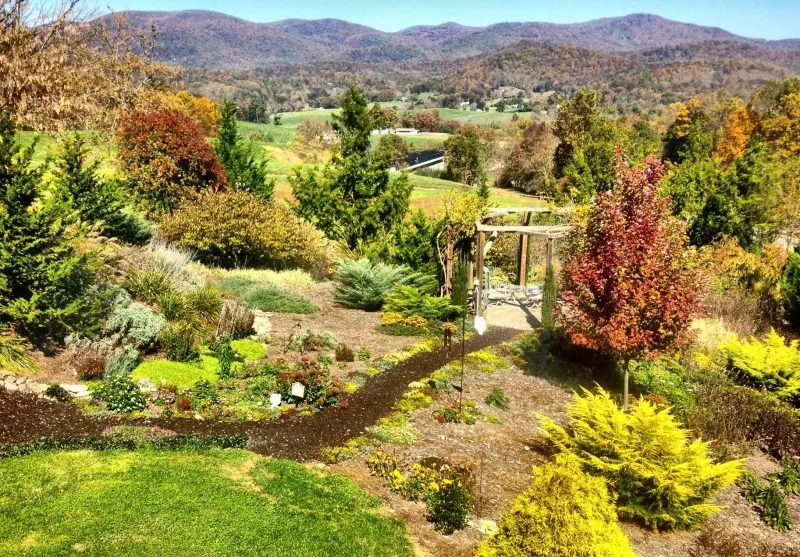

Drive the Blue Ridge Parkway in spring and you can see what a mountain landscape wants to be: tall oaks and tulip poplars overhead, dogwood and serviceberry blooming under them, rhododendron and mountain laurel along the shady banks, ferns and wildflowers at your feet, and a thick layer of last year's leaves holding it all together. Then drive home through most Asheville neighborhoods and you see the opposite: lawn, a row of foundation shrubs from somewhere else, and mulch.
Native landscape design closes that gap. It is not about letting the yard go wild, and it is not a plant list. It is a way of planning a yard around the plants, soil, slopes, and wildlife that already belong in the Southern Appalachians, so the landscape looks like it grew here and mostly takes care of itself. This guide covers how we approach native landscape design in Asheville and across Buncombe County: what "native" really means here, how we design for mountain slopes, clay, and shade, how the layers of a native planting fit together, replacing lawn, planning for four seasons, and how a native design gets planned and built.
What "native" means in the mountains
"Native" only means something when you say where. NC State Extension's gardener handbook defines native plants by ecoregion, and in North Carolina the Blue Ridge ecoregion lines up with the mountains. A plant that is native to the coast or the Piedmont is not automatically at home on a north-facing slope in Buncombe County, and plenty of plants sold as "native" are native to somewhere else in the country entirely.
Inside the mountains, plants also grow in recognizable groups. The NC Natural Heritage Program classifies the state's natural communities, and anyone who hikes around Asheville knows a few of them by feel: rich, moist coves full of ferns and wildflowers; drier oak forests on ridges and south-facing slopes; and stream banks lined with rhododendron. The most useful question we ask on a property is which of those your yard most resembles. A shady, damp hollow behind the house wants cove plants. A hot, rocky bank by the road wants the plants of a dry oak ridge. Designing from that starting point is the difference between a native garden that thrives and one that struggles.
Why bother? Because native plants and native wildlife evolved together. Extension's handbook puts it in a single number: raising one nest of chickadees takes somewhere between 6,000 and 10,000 caterpillars, and those caterpillars feed mostly on native plants. Many insects can only eat the plants they evolved with. Monarch caterpillars eat milkweed and nothing else. NC Cooperative Extension in Henderson County lists the pairings: spicebush swallowtails need spicebush or sassafras, zebra swallowtails need pawpaw, and eastern tiger swallowtails use tulip poplar and wild black cherry. A yard planted with those species is a working part of the landscape around it, not just a pretty one.
Design for the site you have
Native plants are not magic. A native planted in the wrong spot struggles like anything else, so every native design we draw starts with the conditions on the ground.
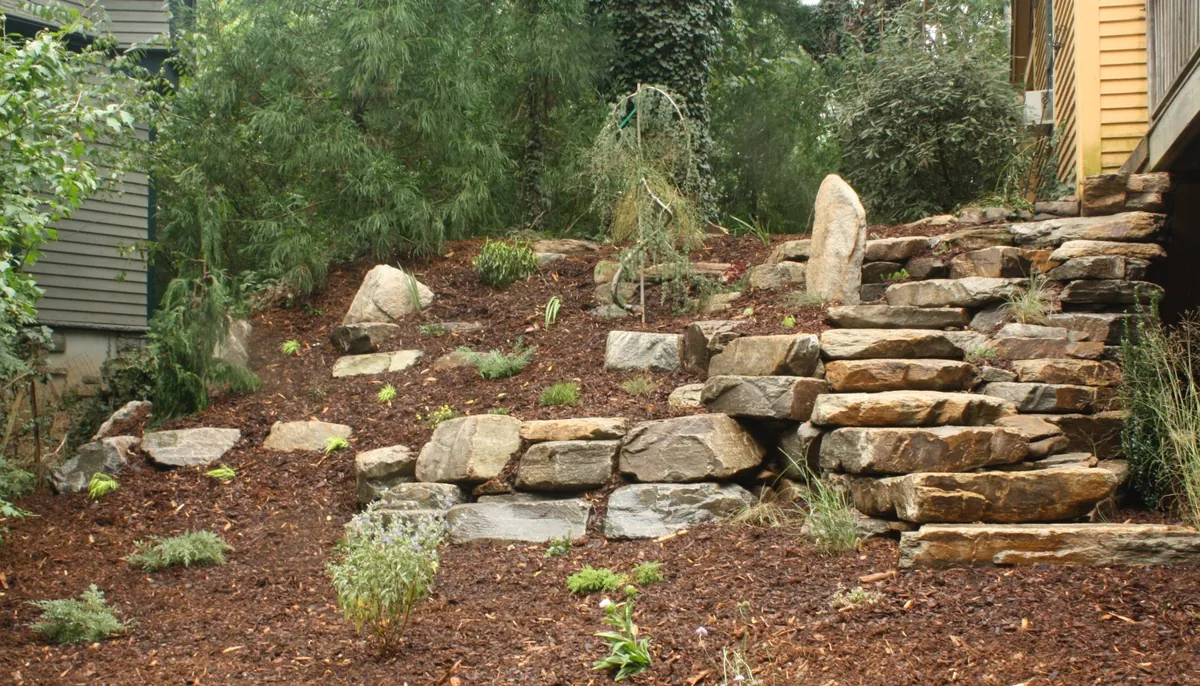
Slopes. Most Asheville lots fall away from the house or climb toward the road. That changes everything: the top of a bank is drier and sunnier than the bottom, water and mulch move downhill, and a slope that is too steep to stand on is too steep to weed. On sloped ground we group plants by where they sit on the hill and lean on deep-rooted shrubs, grasses, and groundcovers to hold the soil. Banks that need real stabilization, terracing, or walls are their own subject, covered in our guide to steep slope landscaping in Asheville.
Clay soil. The red clay under most of Buncombe County holds water in winter, bakes hard in late summer, and is often compacted by construction. Extension recommends testing soil before planting and loosening compaction, working in an inch to three inches of compost where it is needed. North Carolina residents can get a soil test from the NC Department of Agriculture lab at no charge for most of the year; a small per-sample fee applies during the winter peak season, which starts December 1 this year. Many mountain natives are perfectly happy in acidic clay once it drains, so the goal is rarely to replace the soil. It is to fix the compaction and the water.
Shade. Shade is where native design shines in Asheville. Lawn fails under oaks and poplars, while woodland natives, ferns, and sedges are built for exactly that light. A shady yard is not a problem to solve. It is a woodland garden waiting to happen.
Water. Every planting plan we draw accounts for where the water goes in a mountain downpour. Wet spots can become rain gardens or moist borders for plants that like wet feet, and runoff can be carried off in dry creek beds that double as design features. Our guide to yard drainage solutions for Asheville's slopes covers the drains and swales that keep a new planting from washing out.
Layer it like a mountain forest
The single idea that makes native landscapes look natural instead of messy is layering. Extension describes a planting in layers, the same way a forest grows, and we design the same way:
- Canopy. The big trees: oaks, red maple, black gum, American beech, and tulip poplar. Most Asheville lots already have some, and protecting their roots during construction matters more than anything you plant. Where storms opened the canopy, our guide to replanting trees after storm damage covers what to put back.
- Understory trees. The 20 to 40 foot trees that bloom under the canopy: flowering dogwood, serviceberry, redbud, sourwood, Carolina silverbell, and American holly. These carry spring flowers and fall color and feed birds and early pollinators.
- Shrubs. Catawba rhododendron and mountain laurel for evergreen structure, plus Virginia sweetspire, winterberry, arrowwood and possumhaw viburnum, spicebush, and buttonbush in wetter spots.
- Herbaceous layer. Wildflowers, grasses, sedges, and ferns, which Extension calls the most diverse layer in most plantings. Christmas fern, cinnamon fern, and marginal wood fern for shade; little bluestem, switchgrass, and river oats for sun and movement.
- Ground layer. In the forest this is fallen leaves, which shelter the insects that ground-feeding birds hunt. In a yard it is groundcovers and, where it makes sense, leaves left in the beds instead of hauled away.
Two design habits make a layered planting read as intentional. First, plant in drifts rather than ones and twos; Extension suggests groups of at least three to five of each species, which also lets pollinators forage efficiently. Second, give it clear edges and paths. A native bed with a crisp stone edge and a path through it looks designed. The same plants with no edge look abandoned.
Replacing lawn without losing the yard
None of the turfgrasses commonly grown in North Carolina are native, and lawn is the most demanding surface in most yards. We rarely recommend removing all of it. Extension's advice, and ours, is to keep lawn where it earns its place, such as a play area, a spot for the dog, or a path to the shed, and convert the rest.
What replaces it depends on the light:
- Shade: Pennsylvania sedge is one of the best lawn substitutes for dry shade; Extension notes it needs mowing only once or twice a season, though it will not take heavy foot traffic. Moss is another option in damp, acidic shade, along with foamflower, creeping phlox, partridgeberry, green and gold, and native Allegheny spurge.
- Sun: a meadow-style planting of native grasses and wildflowers, framed by a mown edge so it looks deliberate.
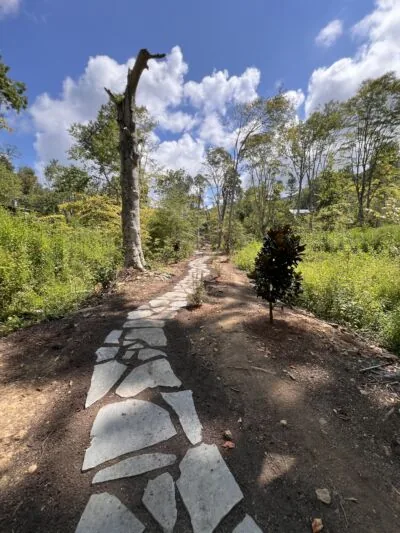
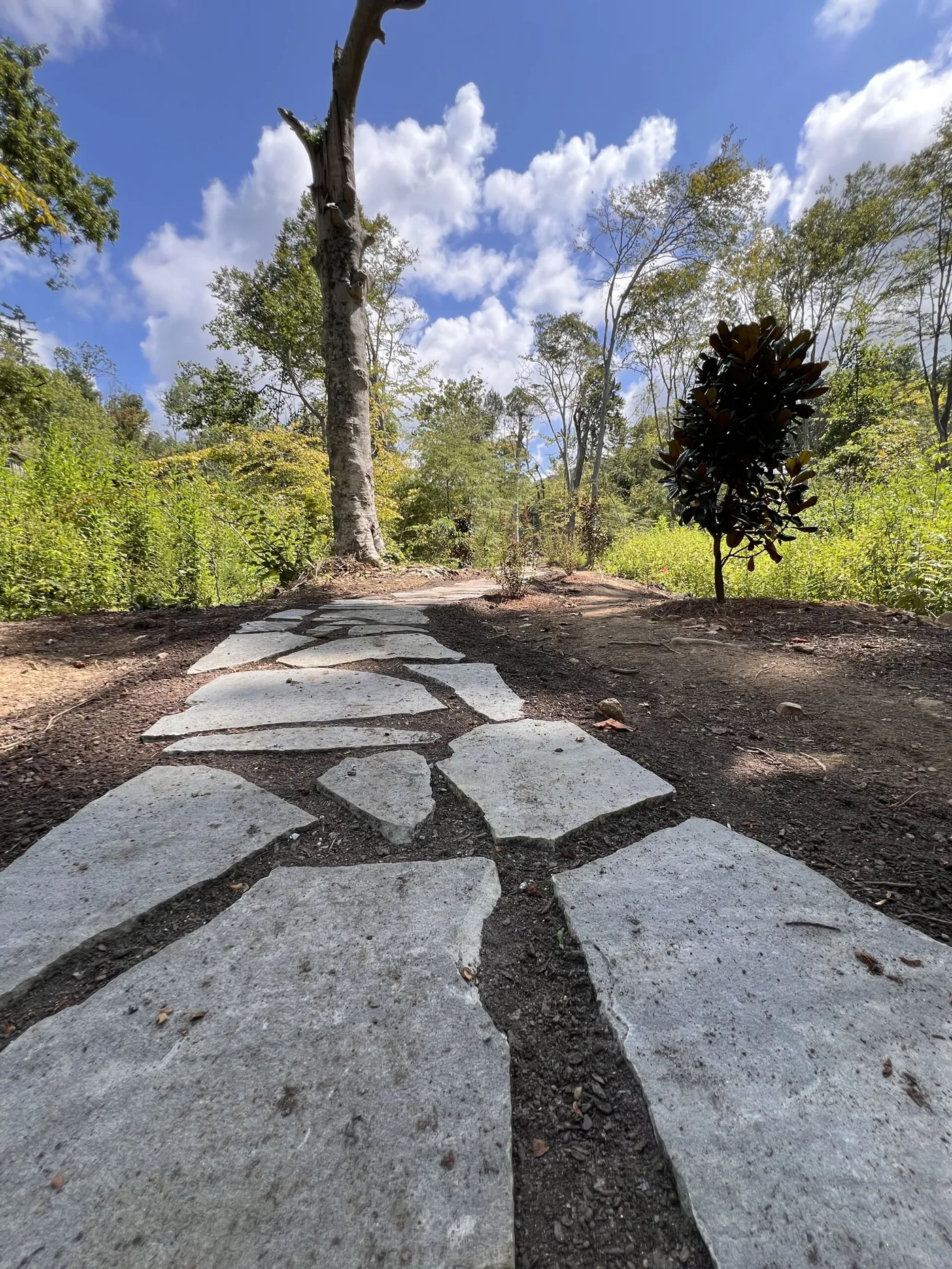
- Traffic: stepping stones, a gravel or flagstone path, or a small patio where people actually walk. Our hardscaping in Asheville page covers the paths and stonework we build to tie a planting together.
Converting lawn is usually done in stages, starting with the patches you mow most and use least. If cutting yard work is the main goal, our low-maintenance landscaping guide covers the mulching, edging, and grading decisions that keep upkeep down.
Four seasons of interest
A common worry is that a native garden peaks in June and looks tired the rest of the year. It does not have to. Extension recommends having at least three native species in bloom in each season, from early spring through late fall, which happens to be good design advice too. A mountain palette makes that easy:
- Early spring: serviceberry, redbud, and dogwood; eastern columbine, green and gold, and creeping phlox below them.
- Late spring into summer: mountain laurel and rhododendron; then butterfly weed, wild bergamot, summer phlox, and mountain mint.
- Late summer and fall: Joe-Pye weed, cardinal flower in moist ground, goldenrod, calico aster, and New York ironweed, with sourwood and black gum turning red overhead.
- Winter: evergreen rhododendron, mountain laurel, American holly, and Christmas fern; winterberry's red fruit; and the tan of little bluestem and switchgrass left standing, which also shelters overwintering insects and seed for birds.
A few choices that matter more than they look
Watch the "nativars." Many native plants are sold as named cultivars. Extension's take is balanced: some cultivars support pollinators as well as the wild species and some do not. Fully double flowers, sterile plants, unusual leaf color, and shifted bloom times can all reduce a plant's value to wildlife. Where habitat is the point, we lean toward straight species or cultivars close to them, ideally from regional sources.
Read the seed packet. A "wildflower mix" is not necessarily native to North Carolina, let alone the mountains. Check the species list.
Remove invasives as you go. Some of the most aggressive invaders in the mountains, such as Oriental bittersweet, English ivy, and privet, are already in a lot of Asheville yards. Extension singles out Oriental bittersweet as a particular problem in the Blue Ridge. Clearing them is part of the job, not an optional extra.
Know your deer and your dog. Native does not automatically mean deer-resistant, and a few natives, rhododendron among them, are toxic to pets. Those are separate questions; our deer-resistant landscaping guide and our notes on pet-friendly landscaping cover them before anything gets ordered.
How we plan and build a native landscape
- Walk the property. We look at sun and shade through the day, slope, soil, where water goes, the trees worth saving, the invasives worth removing, and how you actually use the yard.
- Match the site to a mountain plant community. Cove, dry ridge, stream bank, or a mix. That narrows the palette to plants that will thrive in each part of the yard.
- Design the structure first. Paths, edges, terraces, and drainage go on the plan before any plant does, because they are what make a native planting look intentional.
- Layer the planting. Canopy and understory, shrubs, the herbaceous layer, and groundcovers, in drifts, with something happening every season.
- Prepare the ground. Remove invasives, test and loosen the soil, and handle the water.
- Plant in the right season. Asheville sits in USDA zone 7, and fall is our strongest planting window, with early spring a close second, so roots establish before summer heat.
- Establish, then step back. Water through the first growing season, keep mulch on bare soil, and pull weeds while the plants fill in. After that, a native landscape asks for far less than a lawn.
For Hillary and David in Asheville, that process started with a garden that was already a haven for wildlife. After hurricane damage, we designed a food forest woven along a meandering path, adding native plantings and trees chosen to feed wildlife through every season. You can see how it came together in their Asheville wildlife garden project.
What drives the cost
We do not publish prices for native design, because two yards of the same size can be very different projects. The biggest factors are how much lawn or invasive growth has to come out, how much soil and drainage work the site needs, slope and access, the paths, walls, and other hardscape that give the planting its structure, and the size of the plants at installation. Smaller plants cost less and often establish faster; larger ones look finished sooner. Native landscapes usually cost more up front than another round of lawn and shrubs, and less every year after.
We have been designing and building landscapes across Asheville, Buncombe County, and Western North Carolina since 1997, and native planting is at the heart of how we work. If you are planning landscaping in Asheville and want a yard that belongs in the mountains, look through the landscape projects we have built, where you will also find answers to the questions we hear most, read about our landscape design services, or schedule a consultation and we will walk your property with you.
Frequently asked questions
What is native landscape design?
It is planning a yard around plants that are native to your region and the conditions they evolved in. In Asheville that means the Blue Ridge, or NC mountains, ecoregion. A native design matches each part of the yard to the mountain plant community it most resembles, such as a shady cove, a dry oak ridge, or a stream bank, and layers trees, shrubs, wildflowers, grasses, and groundcovers the way a mountain forest grows, with paths and edges so it looks intentional.
What native plants grow well in Asheville and Buncombe County?
Plants NC State Extension lists as native to the mountains include flowering dogwood, serviceberry, redbud, sourwood, and Carolina silverbell; Catawba rhododendron, Virginia sweetspire, winterberry, and arrowwood viburnum; butterfly weed, wild bergamot, mountain mint, Joe-Pye weed, cardinal flower, and goldenrod; little bluestem, switchgrass, and river oats; Christmas and cinnamon ferns; and groundcovers like Pennsylvania sedge, foamflower, creeping phlox, and partridgeberry. The right choices depend on the sun, slope, and soil in each part of your yard.
Can I replace my lawn with native plants in Asheville?
Usually, yes, though we rarely recommend removing all of it. Keep lawn where you actually use it and convert the rest. In shade, Pennsylvania sedge is a good lawn substitute that Extension says needs mowing only once or twice a season, though it does not take heavy foot traffic; moss and native groundcovers work too. In sun, a meadow-style planting of native grasses and wildflowers with a mown edge looks deliberate. Paths or stepping stones handle the areas people walk.
Will a native landscape look messy?
Not if it is designed. Plant in drifts of at least three to five of each species instead of single plants, give beds clean edges and paths, layer plants by height, and plan for something in bloom or in leaf every season. The same native plants scattered without edges or structure are what look overgrown.
When is the best time to plant a native garden in Asheville?
Fall is the strongest planting window in the mountains, with early spring a close second. Asheville is in USDA zone 7, and planting in fall lets roots establish through the cool months before summer heat. Plan to water through the first growing season. Before planting, get a soil test: the NC Department of Agriculture tests soil for North Carolina residents free for most of the year, with a small fee during its winter peak season.
Thinking about a project like this?
We've been designing and building landscapes across Asheville and Western North Carolina since 1997. Tell us about your property and we'll walk it with you.
Schedule a consultation or call 828-624-5136