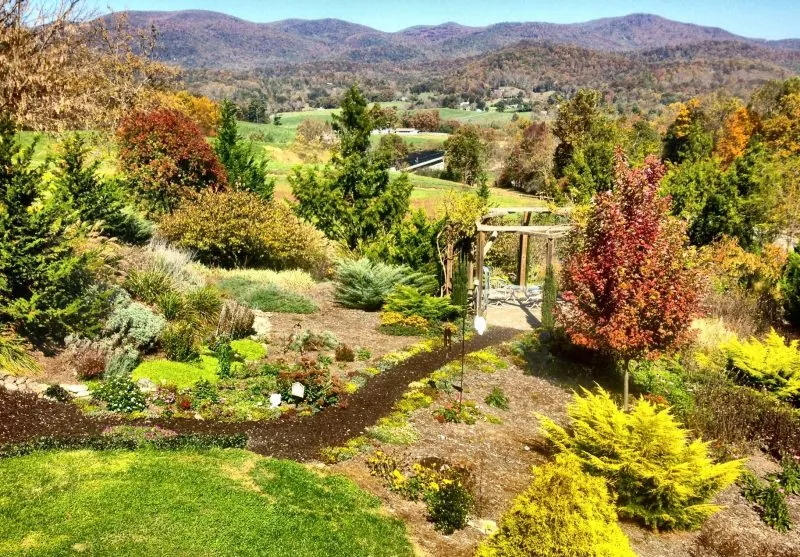

Walk the edge of a mountain meadow near Asheville in late summer and look down. Between the goldenrod and the Joe-Pye weed there is hardly any bare dirt. Low grasses, sedges, and creeping plants fill every gap, and the tall, showy flowers rise out of that green carpet. Now look at a typical garden bed in town: a few plants spaced well apart, with bark mulch in between that has to be topped up every spring and weeded all summer.
Matrix planting is a way of designing a bed or a meadow so it works like the first picture instead of the second. It is the approach we reach for when an Asheville homeowner wants to turn a sunny piece of lawn into something that feeds pollinators, holds the soil on a slope, and does not need mowing every week. This guide explains what matrix planting is, which mountain natives fill each layer, how we convert lawn to a meadow on Buncombe County clay and slopes, and what the first few years really look like.
What matrix planting is
The term comes from naturalistic planting design, and it was popularized in the United States by landscape architects Thomas Rainer and Claudia West in their 2015 book Planting in a Post-Wild World. Their observation was simple: in almost every wild plant community in a temperate climate, the ground is covered. Under the tall plants there is a dense, interlocking layer of lower grasses, sedges, and spreading plants holding the soil. Nature does not leave bare dirt for long, and if a garden does, weeds fill it.
So instead of placing individual plants in a sea of mulch, a matrix planting is built in layers that share the same ground:
- The ground cover layer, or matrix. Low grasses, sedges, and groundcovers planted densely enough to knit together. Rainer and West call it "green mulch," because it does the job bark mulch does, keeping soil shaded, moist, and closed to weeds, while also feeding insects.
- The seasonal theme layer. Mid-height plants planted in drifts that carry one moment of the year: columbine and coreopsis in spring, butterfly weed and bergamot in summer, asters and goldenrod in fall. Out of bloom they blend back into the green.
- The structural layer. A few tall, long-lasting plants repeated through the planting, such as Joe-Pye weed, ironweed, or switchgrass, that give it shape from summer into winter.
- Fillers. Quick, short-lived plants that cover gaps in the first year or two while the slower plants settle in.
The proportions are what set the mood. A planting that is mostly matrix with a few tall accents reads as calm and tidy. More seasonal and structural plants make it wilder and showier. That flexibility is why the same method works for a small bed by the front walk and for a half-acre meadow on a back slope.
Why it suits Asheville yards
Slopes. On a sloped lot, bark mulch slides downhill in every hard rain and bare soil erodes. A planted matrix holds the ground with a dense mesh of roots and leaves year round. On banks that are actively washing out, plants alone are not enough, and the grading, terracing, or drainage work in our steep slope landscaping guide has to come first. On a stable slope that is simply hard to mow, a meadow-style matrix is often the best answer.
Mowing. None of the turfgrasses commonly grown in North Carolina are native, according to NC State Extension, and lawn on a steep or uneven bank is the part of the yard most people dread mowing. NC State's gardener handbook suggests keeping turf where it is the most useful surface and converting the excess to woodland or meadow-style plantings, which is how we approach it.
Weeding. In a conventional bed, every open patch of mulch is a place for a weed to land. Once a matrix fills in, there are far fewer of those openings. It still needs care, but the care changes from constant weeding to a few planned visits a year.
Wildlife. A layered planting of mountain natives blooms from spring into fall and leaves seed heads and hollow stems standing through winter. NC State recommends choosing at least three native species to bloom in each of spring, summer, and fall, which a matrix design does naturally.
Mountain natives for each layer
Every species below is listed by NC State Extension as native to the North Carolina mountains. The right mix for your yard depends on sun, moisture, and slope, and on how much deer pressure you have.
- Matrix, sun: little bluestem is the workhorse, a clumping grass that turns copper in fall and stands through winter. River oats can fill lightly shaded edges, and Pennsylvania sedge carries the matrix into part shade under trees.
- Matrix, groundcovers: green and gold, pussytoes, and creeping phlox fill the low gaps at the front of a bed or between stepping stones.
- Spring theme: eastern columbine, lanceleaf coreopsis, sundrops, and eastern bluestar.
- Summer theme: butterfly weed, wild bergamot, mountain mint, and summer phlox.
- Late-season theme: wrinkle-leaf goldenrod, calico aster, grass-leaf blazing star, and narrow-leaf silkgrass.
- Structure: Joe-Pye weed and New York ironweed, both tall late bloomers that like moist soil, plus switchgrass for height and winter form. Green-headed coneflower works in damp spots.
A few vigorous spreaders deserve a mention. NC State names obedient plant, hardy ageratum, and tall goldenrod as natives that spread fast enough to swamp a small bed and are better saved for meadows and larger natural areas. In a big planting that can be a strength. In a ten-foot border it is a takeover. We also check that every plant is native to the mountains, not just to North Carolina: some popular "native" grasses and shrubs sold around Asheville are native to the Piedmont or the coast. For a wider look at choosing natives for each part of a property, see our guide to native landscape design in Asheville.
Turning lawn into a meadow on a mountain lot
Most of the matrix plantings we build start as lawn. The steps are the same on a small bed and on a large slope; what changes is the scale and how much the ground has to be protected while it is bare.
- Pick the right spot. Sunny lawn that you mow but rarely use is the best candidate. Keep turf for play areas, the dog, and the paths you walk every day.
- Remove the turf without opening the hillside. On flat ground, sod can be stripped. On a slope we avoid tilling, which leaves loose soil for the next storm to carry off and brings buried weed seed to the surface. Smothering the grass under a light-blocking layer for a season, or cutting it out in strips, keeps the soil in place.
- Deal with water and soil. Red clay that stays soggy in winter or a spot where runoff cuts across the yard needs to be fixed before anything is planted. Our drainage and erosion control work covers the swales, drains, and dry creek beds that keep a new planting from washing out. Most mountain natives grow happily in acidic clay once it drains.
- Plant plugs, seed, or both. Seed is the economical way to cover a large, gentle area, and many native wildflowers need a winter's cold before they sprout, so it is sown from late fall into winter. On slopes, small container plants called plugs are more dependable because they do not wash away, and they let us place each layer deliberately. Many of our meadows combine the two: plugs for the matrix and the structure, seed for the in-between.
- Plant in the cool season. Asheville is in USDA zone 7, and fall is our best planting window, with early spring next. Roots establish while it is cool, before the summer heat.
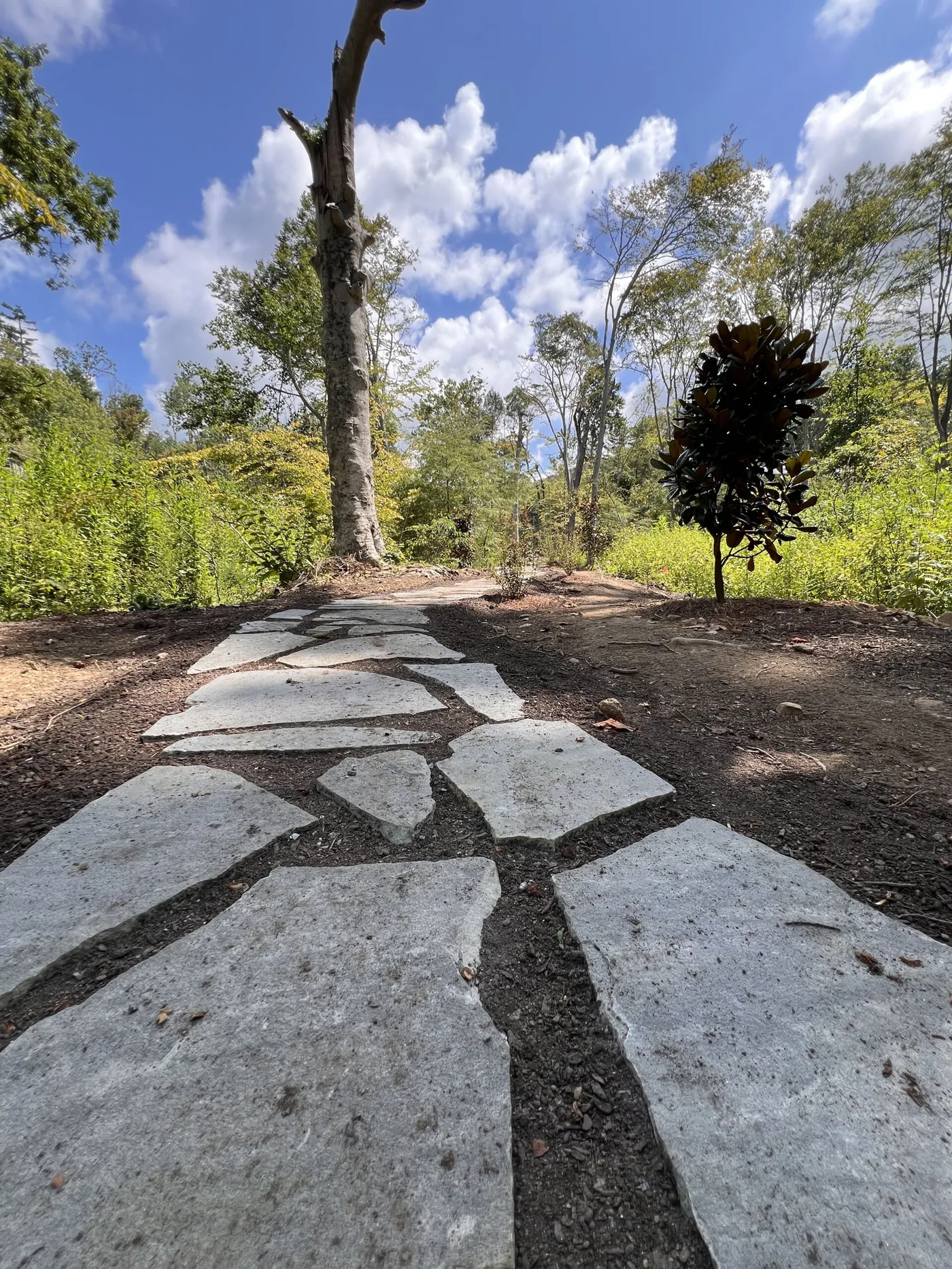
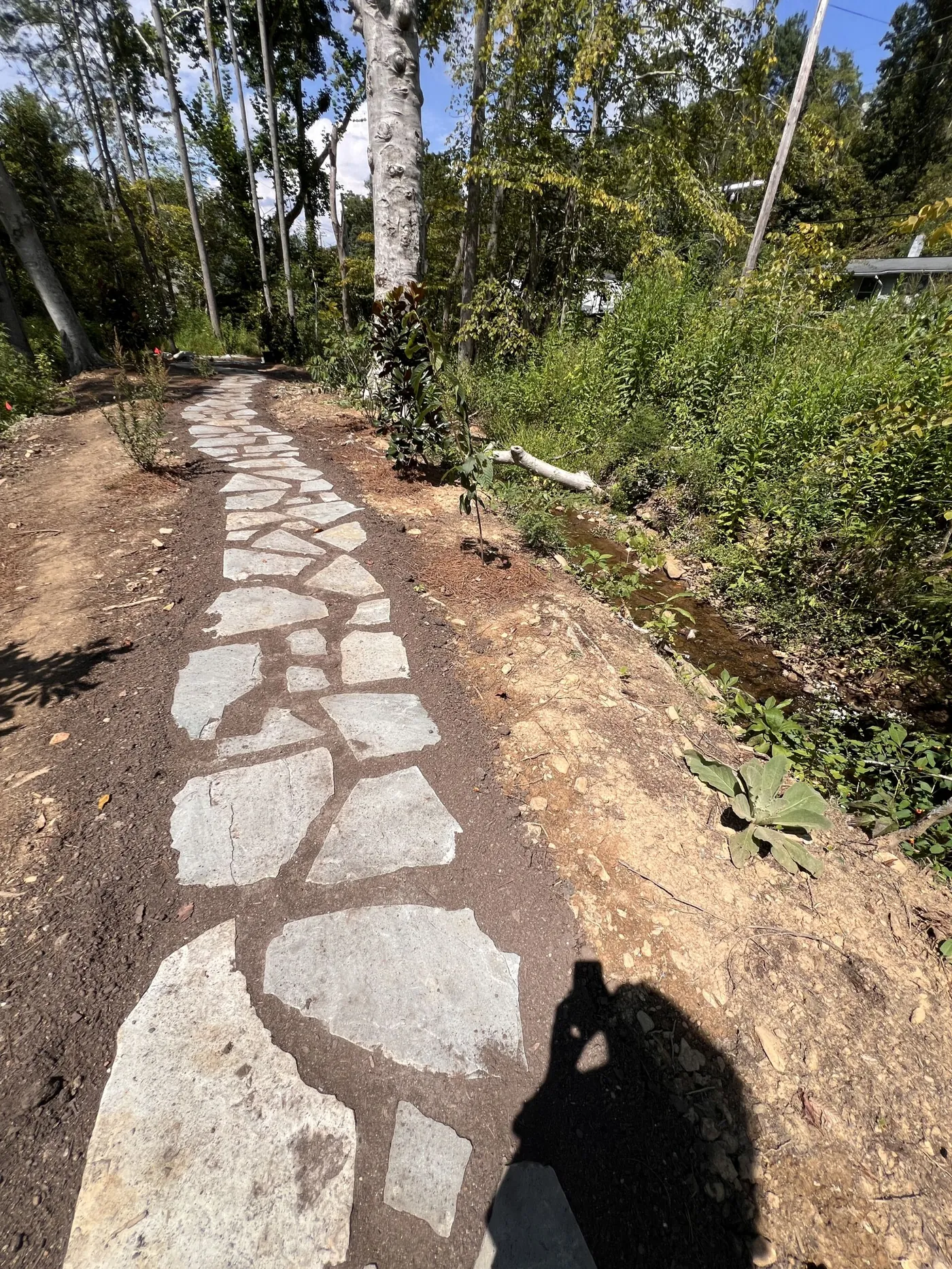
- Frame it. A mown strip along the edge, a stone path through the middle, a bench, or a low wall tells everyone the meadow is on purpose. NC State makes the same point: paths, seating, and fencing communicate that a naturalized yard is cared for. Our hardscaping in Asheville page shows the kind of stonework that gives a planting that frame.
What the first three years look like
This is the part most people are not told. NC State notes that converting turf to a naturalized native planting can take several years and that some stages can look weedier than others. A meadow is a slow build, and knowing what to expect keeps you from giving up on it.
Year one. Native grasses and many wildflowers spend their first season putting down roots, so there may be little to see above ground. Fast annual weeds will try to take the open space. Cutting the weeds back high, above the young plants, keeps them from shading the natives out, and the fillers earn their keep by covering bare patches.
Year two. The matrix starts to close and the first real flowering shows up. Weeding becomes spot work instead of a battle.
Year three and on. The planting knits together and starts to look like the pictures. Care settles into a rhythm: a late-winter cut-back, some editing of anything spreading where it should not, and pulling invasive seedlings when they show up. We leave stems and seed heads standing through winter because they feed birds and shelter overwintering insects, then cut everything back before spring growth begins.
That is far less work than weekly mowing, but it is not no work. If the goal is the lowest possible upkeep in every part of the yard, our low-maintenance landscaping guide covers the other tools: groundcovers, fewer and larger beds, and clean edges.
Deer, neighbors, and other practical questions
Deer. Deer pressure in Asheville neighborhoods varies a lot from street to street, and a meadow is an open buffet if you choose the wrong flowers. We lean the seasonal layer toward plants deer usually leave alone where browsing is heavy. Our deer-resistant landscaping guide explains how we judge that for each property.
HOAs and neighbors. If your neighborhood has covenants about lawn height or plantings, read them before you start, and talk to the HOA if the wording is unclear. A clear edge, a path, and plants in deliberate drifts go a long way toward making a meadow read as a garden rather than an unmown yard.
Pets and kids. A meadow is not a play surface. Keep a patch of lawn or a gravel area for running around, and check plant choices if you have a dog that grazes.
How we design and build a matrix planting
We start by walking the property and noting where the sun falls through the day, how the ground slopes, where the water goes, and how you use the space. Then our designers draw a plan that sets the layers: which matrix plants cover the ground, where the seasonal drifts go, where the tall structural plants repeat, and where the paths and edges sit. Our landscape design service covers that planning process in more detail. Installation follows the steps above, in the cool season, and we stay involved through establishment, because the first two years decide whether a meadow takes hold.
The wildlife garden we built for Hillary and David in Asheville is a good example of a native planting designed around how a family uses its yard, with a path winding through it. You can see the photos on the Asheville wildlife garden project page.
What drives the cost
We do not publish prices for meadow and matrix plantings, because the site makes the project. The biggest factors are the size of the area, how the turf is removed, how much drainage or soil work the ground needs, slope and access for equipment, plugs versus seed and the size of the plants, any paths or stonework that frame the planting, and how much establishment care you want us to handle. A meadow usually costs more to install than reseeding the same patch of lawn, and far less to keep up every year after.
Natural Scapes has been designing and building landscapes across Asheville and Buncombe County since 1997. If there is a sunny slope or a stretch of lawn on your property you would rather not mow, browse our Asheville landscape projects and the common questions answered there, or book a time for us to visit and talk through what could grow there instead.
Frequently asked questions
What is matrix planting?
Matrix planting is a way of designing a bed or meadow in layers that share the same ground, the way wild plant communities grow. A dense ground cover layer of low grasses, sedges, and groundcovers (the matrix) covers the soil in place of bark mulch, drifts of seasonal flowers rise out of it, and a few tall structural plants repeat through the planting. The approach was popularized in the United States by Thomas Rainer and Claudia West in their 2015 book Planting in a Post-Wild World.
Can I turn my lawn into a native meadow in Asheville?
Usually, yes. Sunny lawn that you mow but rarely use is the best candidate; keep turf where you play, walk, or let the dog out. On a slope we remove the grass by smothering it or cutting it out in strips rather than tilling, fix any drainage problems, and then plant plugs, seed, or both in the cool season. A mown edge and a path through the planting make it read as a garden.
Which native plants work in a matrix planting in the NC mountains?
Plants NC State Extension lists as native to the mountains include little bluestem, switchgrass, and river oats; Pennsylvania sedge for part shade; green and gold, pussytoes, and creeping phlox as low groundcovers; eastern columbine, lanceleaf coreopsis, butterfly weed, wild bergamot, and mountain mint for spring and summer; and goldenrod, calico aster, Joe-Pye weed, and New York ironweed for late summer and fall. The right mix depends on sun, moisture, slope, and deer pressure.
How long does a native meadow take to establish?
Plan on about three growing seasons. In the first year most native grasses and wildflowers are building roots, so there is little to see and weeds need cutting back above the young plants. The planting starts to fill in and flower in the second year and usually knits together by the third. NC State Extension notes that some stages of a turf-to-meadow conversion can look weedier than others, which is normal.
When is the best time to plant a meadow in Asheville?
Fall is the best window for planting plugs in Asheville, which is in USDA zone 7, with early spring next, so roots establish before summer heat. Native wildflower seed is usually sown from late fall into winter, because many species need a period of cold before they germinate. On slopes, plugs are more dependable than seed alone because they do not wash away in heavy rain.
Have a slope or lawn you would rather not mow?
Our designers plan meadows and layered native plantings for Asheville yards and build them in the right season. Tell us about your property and we will come take a look.
Schedule a consultation or call 828-624-5136